Shop sustainably. See our

Better Trail Certified gear.
MENU
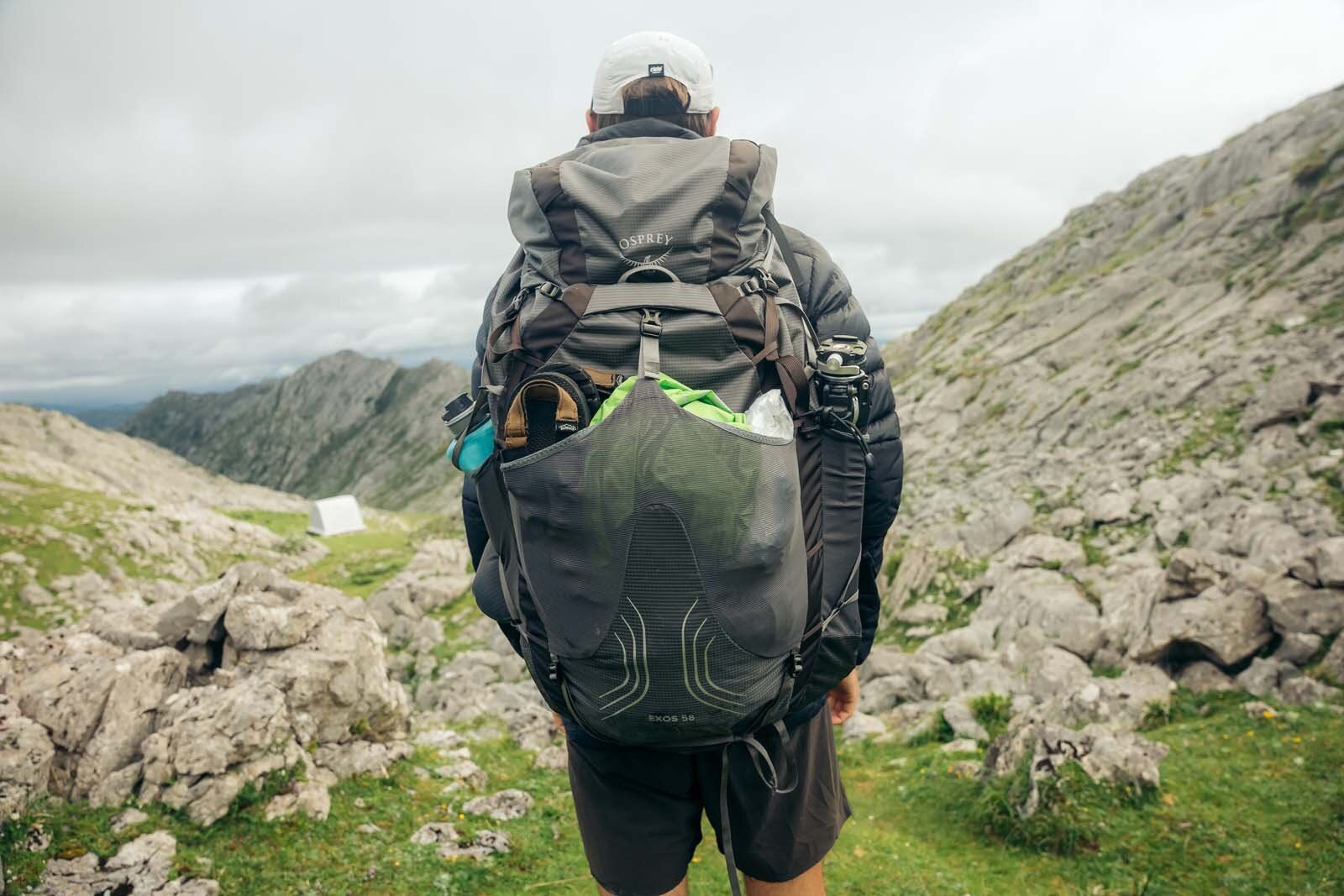
Rear view of packed Osprey Exos 58 backpacking backpack

Osprey Exos 58 Backpack Review

Eli Bernstein bio photo
ByMultiple Authors

Updated:

Jan 20, 2025
When you buy through our links, we may receive a commission.
Our Take:
4.5/5
The Osprey Exos 58 ($260) is a thoroughly modern backpacking pack that we recommend for a wide variety of users. Its design splits the difference between the ultralight and traditional backpack categories, offering a Goldilocks level of support and padding for loads up to 35 pounds, simple fit adjustments, and enough storage options for all but the pickiest packers. The Exos’s nylon material won’t hold up to heavy use as well as Dyneema, but the pack’s reasonable price and weight hit a sweet spot, making it an approachable pick for everything from weekend trips to extended thru-hikes.
Comfort

Comfort

4/5
Organization

Organization

3.5/5
Weight

Weight

4/5
Durability

Durability

2.5/5
Water Resistance

Water Resistance

2/5
Sustainability

Sustainability

4.4/5

Weight

2 lb. 13.4 oz.

Capacity

58L (38, 48L)

Stated Load Limit

35 lb.

Material

100D & 400D nylon

Pros

Impressive comfort, storage, and carrying capacity for a pack this light.
Trampoline-style backpanel promotes airflow and isolates your torso from the main compartment's contents.
Adjustable torso length is easy to toggle and ensures a just-right fit.

Cons

Lightweight nylon isn’t as durable as heavier materials or Dyneema.
No included rain cover.
Only two sizing options, which cater to those with torso lengths from 17 to 23 inches.

The last Osprey pack I used was from the 2010s, and the Exos 58 impressed me with how far the company has advanced since then. Simply put, it provides a level of carrying comfort unparalleled in any other lightweight backpacking pack I’ve tried. A lot of ultralight packs have a simple foam backpanel, but the Exos’ trampoline-style mesh backpanel and streamlined-yet-padded hipbelt really up the comfort game and offer great lower back support. Tack on the added rigidity of the lightweight metal perimeter frame, and the Exos made carrying loads up to 35 pounds a breeze.

I tested the Osprey Exos 58 on several short backpacking trips, including outings in Norway’s Lofoten Islands and Spain’s Picos de Europa mountains. I appreciated how its suspended mesh backpanel completely isolated my back from the pack’s contents—especially helpful when I maxed out the Exos’s carrying capacity with 15 extra pounds of camera gear. The mesh construction also promoted airflow, helping my back stay relatively sweat-free. The shoulder straps were a final highlight: My collarbone tends to form a bump while carrying a heavy pack, but the Exos’ ample padding eliminated this issue altogether. Overall, this pack handles multi-day backpacking loads superbly and I’d recommend it for all but the most gear-intensive trips.

Hiking near lake in Osprey Exos 58 backpacking pack

Despite its relatively low weight, the Osprey Exos 58 boasts plenty of pockets for organizing gear of various sizes. The main compartment is spacious and easy to load from the top thanks to a wide opening with a one-handed drawstring cinch. I fit a two-person tent, 15-degree sleeping bag, and sleeping pad in the base of the Exos’s main compartment and still had ample room for food, layers, and personal items for our three-day trip in shoulder season conditions. The pack also features a removable top lid with two separate zipped compartments, one internal and one external. I used the external pocket for my headlamp, toiletry bag, and snacks, and kept maps, my med kit, and car keys in the internal pocket (it contains a small key carabiner).

The Exos features two large, stretchy water bottle pockets—one on each side. I easily fit a 1.5-liter soft flask in one pocket and my camera tripod in the other, and was able to quickly access my water while I was moving on the trail. There’s also a spacious mesh pocket on the front of the pack, ideal for stashing my rain gear and dirty clothes. Finally, the Exos has an internal water reservoir sleeve, which is standard issue these days but nonetheless another user-friendly feature.

View of contents inside main compartment of Osprey Exos 58 backpacking pack
Osprey Exos 58 backpacking pack hipbelt zipper

The Exos lands in the middle of the weight spectrum for backpacking packs. A 2 pounds 13.4 ounces, it’s heavier than true ultralight models, which hover around two pounds but have inferior load-bearing capacity, less comfort and storage, and often (but not always) compromised durability. For example, the REI Co-op Flash Air 50 (read our Flash Air 50 review) weighs 1 pound 14 ounces but is rated for 25 pounds (less than the 35 lb. we comfortably carried in the Exos) and lacks a breathable suspended-mesh backpanel.

Conversely, heavier packs—such as the classic Gregory Baltoro (4 lb. 14.4 oz. for the 65L) and Osprey’s standard Atmos AG reviewed here (4 lb. 5 oz. for the 50L)—are built with burlier fabrics and allow users to schlep bulkier loads comfortably. However, the increased weight of the packs themselves is something you’ll notice as the miles add up, and not everyone needs the plethora of storage and padding that these packs offer. Given the performance tradeoffs in both directions weight-wise, the Exos is a jack-of-all-trades for most backpackers, as long as you’re not aiming for an uber-minimalist thru-hike or a multi-week expedition requiring a ton of gear.

As I mentioned above, the Exos sacrifices a bit of durability to keep weight—and cost—down. Its 100-denier nylon material (with 400D reinforcements on the bottom) is relatively lightweight, but far from tissue paper thin. After my week-long testing period, I didn’t notice any signs of wear except for a few snags on the water bottle pockets, which (along with the front stash pocket) are made of mesh and are naturally less durable than solid nylon.

The rest of the Exos’s materials and components, including the straps, buckles, and seams, feel high-quality, which is on par with what we’ve come to expect from Osprey. A Dyneema pack like the Hyperlite Southwest (read our Southwest review) will certainly hold up better to heavy use (and is effectively waterproof), but will also cost significantly more (the 55L Southwest is $379). For a more budget-friendly option that will still get the job done throughout multiple seasons, the Exos is a solid choice.

Osprey Exos 58 Backpack side view and front stuff pocket

Unfortunately, the Exos does not come with an included rain cover, a puzzling choice given how many other Osprey models include this feature (including the Aura AG LT 50 we tested). Sure, this saves a tiny bit of weight, but I’d rather not have to buy a rain cover separately, which I had to do given that the Exos’s thin nylon fabric is prone to soaking through in anything more than a short drizzle (especially if you don’t keep the PFAS-free DWR clean of dirt). We recommend investing in dry bags or a pack cover if you’re heading into wet weather with the Exos and want your gear to stay dry.

Select icon to view details:

Icon
Icon
Icon
Icon
Icon
Icon
Icon
Icon
Icon
Icon

Longevity

Choosing durable outdoor gear is perhaps the most effective way to reduce environmental impact—the longer it lasts, the less it needs to be produced. Our proprietary longevity rating evaluates overall build quality based on factors such as materials, fabric denier, component durability (including zippers and toggles), real-world performance as reported by our field testers, and our experiences with the brand.

Tester: 6’2” 175 lb.; 18.5” torso length

Size tested: Men’s L/XL

The Osprey Exos (men’s version) comes in S/M and L/XL sizes, while the women's Eja is available in XS/S and M/L. My torso length of 18.5 inches put me between the men’s sizes and I decided to size up, which was the right call. An adjustable torso-length system on the backpanel helped me dial in the fit I needed, and although the hipbelt isn’t adjustable, the Exos molded perfectly to my body.

Ladder torso adjustment on Osprey Exos 58 backpacking pack

Gregory Focal 58 ($250): The Lookalike
If you removed their logos and colorways, at first glance you might think the Gregory Focal 58 was the same pack as the Exos. The Focal also has a trampoline-style backpanel with airy mesh that extends through the hipbelt, in addition to oversized water bottle pockets, a mesh dorsal pocket, and a removable top lid. At 2 pounds 10.4 ounces, it’s a little lighter than the Exos and costs $10 less. Overall, these backpacking packs are pretty evenly matched, but we give the Exos the slight edge given its thicker foam shoulder straps and adjustable torso length. But while it’s not as adjustable, the Focal comes in three size options compared to the Exos’ two.


Granite Gear Crown3 60 ($260): More Customizable
The Granite Gear Crown3 60 is lighter than the Exos while offering more storage space. This pack is aimed more squarely at thru-hikers and is more customizable than the Exos—you can remove its top lid, hipbelt, and plastic frame sheet (or add an aluminum stay), or turn the top lid into a waist pack in combination with the hipbelt. The newest Crown3 is also more durable, with 100-denier Robic nylon and 210D accents (Robic nylon is considered significantly stronger and more tear-resistant than standard nylon), and its large water bottle pockets are solid nylon, not mesh. However, its foam straps are much less cushy than those of the Exos, and it has a solid backpanel instead of the Exos’ more breathable trampoline-style version. The Crown3 is a more versatile pack for those who love to tweak their gear, but in terms of comfort and quality, the Exos comes out on top.

Osprey Exos 58 ($260)
Rear view of packed Osprey Exos 58 backpacking backpack
4.5/5

Splitting the difference between minimalist UL models and fully featured haulers, the Exos (women's Eja) is one of the best options for those curious about lightening their load. However, it’s not as durable or lightweight as many true-blue ultralight packs.  

Weight
2 lb. 13.4 oz.
Capacity
58L (38, 48L)
Stated Load Limit
35 lb.
Material
100D & 400D nylon
Icon

Comfort

4/5
Icon

Organization

3.5/5
Icon

Weight

4/5
Icon

Durability

2.5/5
Icon

Water Resistance

2/5
Icon

Sustainability

4.4/5
Granite Gear Crown3 60 ($260)
Closeup of the Granite Gear Crown3 Backpacking backpack
3.9/5

The Crown3 is a ’tweener backpack that incorporates highlights from both ultralight packs and fully featured models. Its padding isn’t very plush and the materials could be more durable, but the customizable build makes it a functional, do-it-all option. 

Weight
2 lb. 9.3 oz.
Capacity
60L (40L)
Stated Load Limit
35 lb.
Material
100D & 210D Robic nylon
Icon

Comfort

3/5
Icon

Organization

3.5/5
Icon

Weight

3.5/5
Icon

Durability

3/5
Icon

Water Resistance

2/5
Icon

Sustainability

0/5
Osprey Atmos AG 65 ($340)
Posing in Osprey Atmos 65 AG backpacking backpack
4.5/5

Osprey's “classic” backpacking pack, the well-rounded Atmos (women’s Aura) prioritizes comfort and user-friendliness, highlighted by a trampoline-style mesh backpanel and copious pockets. The weight and steep price are hard to ignore, though.

Weight
4 lb. 9.8 oz.
Capacity
65L (50L)
Stated Load Limit
40 lb.
Material
210D & 500D nylon
Icon

Comfort

4.5/5
Icon

Organization

4.5/5
Icon

Weight

2/5
Icon

Durability

4/5
Icon

Water Resistance

4/5
Icon

Sustainability

4.4/5

Is the Osprey Exos 58 for You?

The vast majority of backpackers are looking for one pack that will work on a wide variety of trips. If that sounds like your goal, it’s hard to go wrong with the Osprey Exos 58. Light but not too minimalist, comfortable but not overbuilt, this pack offers an ideal combination of weight, features, and price. Aside from chasing FKTs or mountaineering objectives, we’d happily wear this backpacking pack on just about any type of trip. Its relatively thin nylon fabric may not hold up as well as some other top-of-the-line light packs, but the Exos will certainly last long enough to make it a worthwhile investment.

Looking out over view wearing Osprey Exos 58 backpacking pack

hit the trail

Learn More About Hiking Gear